



Some of us are lucky — we already know what we want to study before we go to college. If you’re the class math whiz, someone who’s been passionate about music or art for as long as you remember, or you simply have a head for business at an early age, you’ve already got a leg up on what studies you will pursue.
For the rest of us, it’s not so easy. There might be a variety of things you find interesting or that you’re good at but have no idea how that will translate into career success. This makes it less clear where you should focus your attention once you get to college. If you fall into this category, you may be lost on how to choose your college major. Here are some handy tips to help!
What Is a Major?
Let’s start with the basics. Your major is the subject you specialize in while in college, for example, psychology or business. You will take a large portion of your classes in this subject area, usually 12 to 15 out of a total of 40 classes for your undergraduate degree.
Your major gives you a complete area of study in one subject, which will likely qualify you for entry into a career of your choice or graduate study in the same, or a closely related area of study. Choosing the best major for you is crucial.
When Do You Declare a Major?
Colleges will likely ask you to declare your intended major on your college application. But don’t panic! Most colleges have the option of allowing you to be an “undeclared major,” letting you take classes for a year or two until you have decided what course of study you want to commit to.
If you decide to change your major at some point after you’ve declared it, it’s most often an easy, painless process. In fact, at some schools, a majority of students change their majors during their academic careers. Some of us, myself included, change our majors more than once. In most cases, this has a minimal effect on the length of time required to complete your studies.
How to Choose Your College Major
There are a few key considerations you want to take into account before you commit to a major area of study. Certainly, you will want to clarify your financial expectations and the cost of your education.
However, more importantly, you will also want to reflect on your personality and values and how these will affect your choice of a satisfying area of study.
Finally, you will want to determine which sectors and careers have the most growth potential since a significant reason for attending university is to prepare for your future.
What Are You Passionate About?
If money were our only consideration, we’d all become investment bankers, corporate CEOs, or famous actors. However, let’s face it; we’re not all satisfied with these kinds of careers. To decide what course of study to pursue, it’s important first to ask ourselves what we’re good at and what makes us feel really enthusiastic.
Identifying our passions, values, abilities, and interests is the first step in setting out on a rewarding career. You’ve probably already gotten some idea of your talents and interests from the classes you did well in at high school.
For example, have you followed politics for as long as you can remember? How might this interest combine with your values? If you are deeply concerned with social justice, you might work with an NGO or become a journalist.
A large part of what guides our passions is what sort of personality we have. There are many tools that can help you decide on the best college major for your distinct style of thinking.
One of the most popular is the Myers-Briggs Type Indicator, a personality assessment test that divides people into 16 psychological types. Whether you are introverted or extroverted, thinking or feeling, prefer decision-making or gathering information can be key in your choice of major, minor, and future career. As an Introverted, Intuitive, Feeling, Perceptive (INFP), I can attest that most of what the Myers-Briggs says about skills, deepest motivations, and future career success is quite accurate.
Consider Future Factors
It’s all well and good to home in on the college major that is going to provide the most satisfaction moving forward. But now that you’ve done that, it’s necessary to give serious consideration to how you can translate this into a successful career.
Indeed, studying what you enjoy most will make your college years really fun. However, if you discover that the market for your skills is severely limited upon graduation, you might find yourself wishing that you had studied something else. Ask yourself the following questions to help with your decision.
Which Fields Are in High Demand?
An essential factor in which college major we decide upon is how it will translate to a satisfying career and salary. Part of this equation is looking at employment rates and trends in the field you wish to study. Will your chosen major lead to steady employment that will be around well into the future?
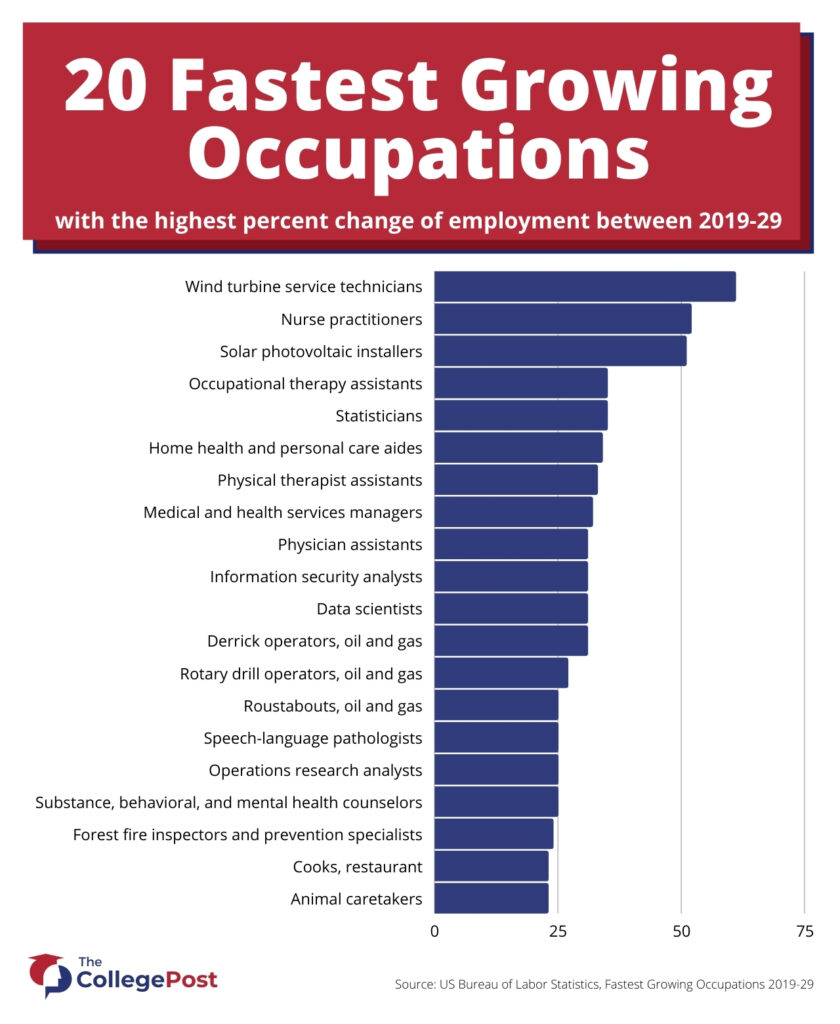
Despite a continued trend toward automation in many sectors, a number of fields have been in high demand and look set to continue, such as marketing, communications, human resources, culinary arts, and education.
The market for those with computer skills or medical training will also likely soar far into the future. Careers in mathematics, statistics, and renewable energy are also expanding rapidly.
However, according to the Bureau of Labor Statistics, many secure, age-old staples such as manufacturing, construction, clerical, and service occupations are on the decline. The outlook is similar for all aspects of nuclear power and careers in the postal service.
Other traditional careers, such as hard copy journalism and publishing, have mostly transitioned online, making software and internet skills training much more important.
What Are Your Future Salary Expectations?
A high salary might seem like a no-brainer. However, if you want to make a high salary, but your dream job is to work in early childhood education, you might be in for a disappointment. Salaries for pre-kindergarten teachers are among the lowest in education.
If your expectation is a great financial reward, it is a far better bet to study law, business, or enter a STEM (Science, Technology, Engineering, Medicine) field. The highest median salaries are in these fields, while the lowest are in occupations such as education, social services, psychology, and the arts.
However, when looking at the entire span of people’s lifetimes, graduates in so-called “low paying” fields often make nearly as much as their high salary counterparts.
Therefore, don’t let that throw you if you want to study something “impractical” as an undergraduate student. Many employers now actively seek out those with, for example, liberal arts degrees, as these subjects impart skills such as critical thinking, which they value highly.
Also, if you’re really passionate about, say, philosophy, it’s hard to imagine better preparation for law school than the logical analysis this discipline teaches.
Furthermore, if teaching is your thrill, keep in mind that salaries in education are not always as low as people think. Depending on your subject and location, average annual teaching salaries can run as high as $70,000 in Washington DC, for example.
Return on Investment
Education is expensive. Many students are concerned about how much their education will cost compared to how much money they will make after graduation. This is your Return On Investment (ROI), an essential consideration as you determine your educational future.
According to one list, the major with the highest ROIs is English (surprise!). The skills acquired in an English program include excellent writing, textual analysis, and logical argument, all highly prized among prospective employers. Top jobs for English grads are speech writing, communications management, and content management, with median salaries from $78-$88,000.
Marketing, engineering, biology, and economics round out the top five highest-earning college majors.
Other factors to consider regarding ROI are whether you choose to go to a private college or a state university and whether you can get financial aid such as grants and scholarships.
Do Your Research
You may find the array of choices and considerations about what you’re going to major in dizzyingly complex. Give yourself time to research the possibilities. There is a vast wealth of resources online to help you narrow down your choices.
If you’re like me, there are many things that capture your interest, but you might be indecisive about which subject to pursue or how it will translate to a future career. I asked my high school guidance counselor what sorts of jobs I could get with a psychology degree (counseling) or studying history (teaching).
Use Your Network
Like nearly all high school seniors, I talked to my friends about their academic plans and what kind of job they wanted. Doing informal research this way can lead you to older students who have majored in various subjects, which will allow you to ask questions such as, “What’s the best thing and the worst thing about studying physical therapy,” for example.
You can ask older adults what they liked and didn’t like about their studies, if it helped them find a satisfying career, or even what they wish they had studied.
Take a Test Drive
Finally, there are various internships, volunteer, and work experience programs to give you a taste of different careers.
Think you want to be a doctor? Volunteer at a hospital. Wonder if you’d prefer the corporate world? Look for internships in business. Want to work with people with mental health or substance abuse issues? There are volunteer counseling programs that will help you test the waters.
Take advantage of the many opportunities to get some real-world experience that will help you choose your college major.
Once you have given serious thought to your career goals, values, how much you are willing to spend, and what gives you real personal satisfaction, it should become much clearer what direction your university study will take you.
The most important thing to remember is that you still have time to decide. If, like most people, you start off majoring in something and later decide you want to switch, don’t sweat it. Your college years are meant to be a time of exploration and discovery, so above all, enjoy yourself.
